


Paiwan residents from Taitung County’s Daren Township (達仁) yesterday demonstrated outside the Executive Yuan in Taipei, protesting the government’s attempt to buy Aboriginal land at prices as low as NT$68 per square meter.
“Land represents life in our culture, and it is not considered an honorable thing for us to sell land that has been passed down from generation to generation,” former Daren mayor Chang Chin-sheng (張金生) said during the protest. “We understand the government wants our land for a road project. However unwillingly, we know we should sell the land to the government — but can you at least offer us a reasonable price?”
Chang was referring to a project by the Directorate-General of Highways to widen and improve Provincial Highway No. 9, which passes through the township.
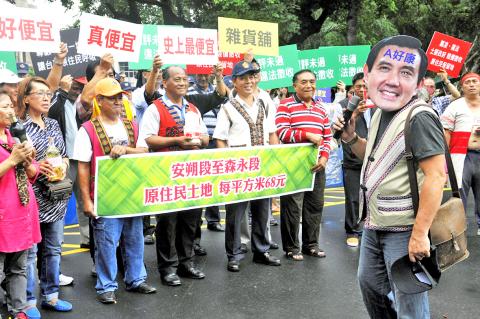
Photo: George Tsorng, Taipei Times
“The government has taken away much of our land, and the Forestry Bureau’s logging in the mountains has caused mudslides,” Chang said. “We no longer have much of our traditional land left, how can you try to buy more at such a low price?”
Chang added that Taiwan Power Co (台電) paid NT$3,000 per square meter to build power supply facilities in the township.
Another protester, Hou Chin-chu (侯金助), said that it is especially unacceptable that the agency “threatened” landowners with forcible expropriation if they refuse to sell their land at the price offered by July 9.
Chen Ying (陳瑩), director of the Democratic Progressive Party’s Department of Aboriginal Affairs, accused the government of failing to follow proper legal procedure in negotiating with the locals.
“According to the Aboriginal Basic Act (原住民族基本法), the government needs to negotiate with the entire community when it wants to do something in a traditional Aboriginal domain,” said Chen, a Puyuma and a native of Taitung County. “However, no such negotiation took place before the agency made its decision.”
Representatives from the protesters later met with Cabinet Deputy Secretary-General Hsiao Chia-chi (蕭家淇), who agreed to make concessions.
“I will ask the Taitung County Government, which has the power to decide the purchase price, to reconsider its price proposal,” Hsiao said. “I will also ask the Ministry of Transportation and Communications to avoid causing any damage in the environment during the construction and to postpone the deadline, as well as call a meeting to explain the details of the project to landowners before the new deadline.”

The National Chungshan Institute of Science and Technology yesterday showcased its locally developed variants of the Vision 60 robotic patrol dog, which it plans to deploy on the nation’s outlying territories in the South China Sea. The variants were produced under the Joint Lab project — created by the institute and domestic companies — and assembled with domestically produced motors, lenses and artificial intelligence (AI) systems alongside licensed tech from the US, Missile and Rocket Systems Research Division deputy director Jen Kuo-kang (任國光) told the media event at a military base in Taipei’s Dazhi (大直) area. Taiwan has built up its strengths

RIGHT DIRECTION: Taiwan’s efforts to prevent forced labor include a proposal to ‘fully prohibit’ employers from withholding workers’ documents, an official said Taiwan is to establish a mechanism to restrict imports of goods linked to forced labor, the Executive Yuan said yesterday, after the US proposed imposing additional tariffs on Taiwanese goods over labor concerns. “The Ministry of Labor and the Ministry of Economic Affairs are to establish an interministerial review procedure,” Executive Yuan spokesperson Michelle Lee (李慧芝) said at a news briefing in Taipei. “The government is to use the Foreign Trade Act [貿易法] as the legal basis to restrict imports of goods produced with forced labor” and bring its supply chain governance more in line with international standards on human rights, resilience
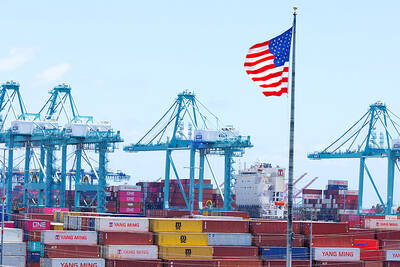
NOT IMMEDIATE: Taiwan has a chance to appeal the proposed 10 percent tariff before it starts, while other countries face a 12.5 percent tariff from the trade office Taiwan is among 60 economies determined by the US to have failed to impose or enforce a ban on the importation of goods produced with forced labor, according to a notice released on Tuesday by the Office of the US Trade Representative (USTR), which proposed imposing an additional 10 percent or more tariff on them. The USTR in a statement said that following an investigation, it had determined under Section 301 of the Trade Act of 1974 that the failure of the 60 economies to impose and effectively enforce a prohibition on the importation of goods produced with forced labor is
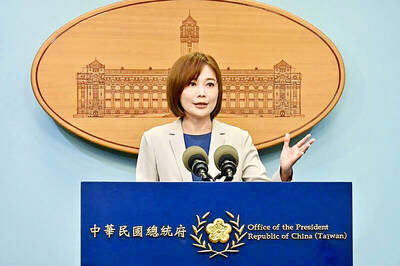
TIT-FOR-TAT: The US allegedly revoked the visa of a Chinese national working at Xinhua News Agency in the US in response to Beijing’s expulsion of Vivian Wang The Presidential Office yesterday condemned China for expelling a New York Times correspondent from Beijing following the newspaper’s interview with President William Lai (賴清德), saying the move highlighted Beijing’s suppression of press freedom and its threat to international news media. Taiwan has noted a series of recent incidents in which Beijing used similar tactics to “threaten and pressure international media outlets and journalists,” Presidential Office spokeswoman Karen Kuo (郭雅慧) said in a statement. “This concerns not only press freedom and freedom of expression, but also the safety of journalists, and Taiwan and relevant partners are paying close attention to the situation,” she


 RSS
RSS